// why it matters
Most control networks have no one watching them.
U.S. government reports keep finding the same things: office and control networks that aren’t kept apart, remote access that attackers use, and too little monitoring to notice.
94.4%
“The USCG found that 94.4% of their assessed entities had default passwords in place.”
U.S. Coast Guard findings in CISA Analysis: Fiscal Year 2023 Risk and Vulnerability Assessments, September 2024 (CISA, PDF)
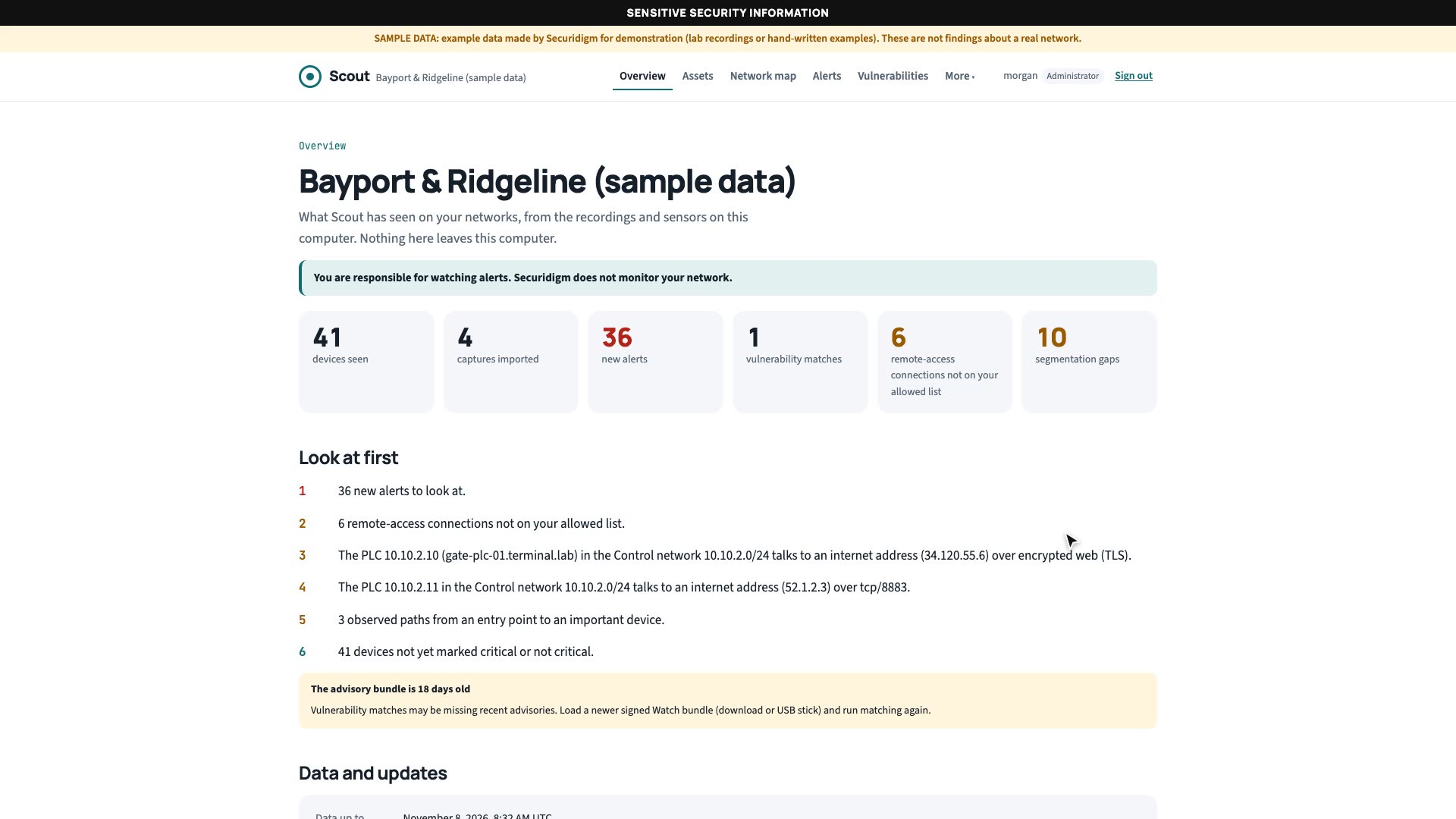
Scout flags default SNMP passwords and remote logins sent unencrypted that it sees on your network.
71%
“There was a 71% year-over-year increase in the use of stolen or compromised credentials in reported cyber incidents”
U.S. Coast Guard, on its 2024 maritime cyber trends report, May 19, 2025 (Coast Guard)
Scout lists every remote and vendor connection it sees, and flags sign-ins from new places.
5 years
“maintaining access and footholds within some victim IT environments for at least five years”
CISA, NSA and FBI advisory AA24-038A, February 7, 2024, on intrusions that included the Transportation Systems sector, using tools already built into the systems (CISA)
Scout watches the network itself, so it doesn’t depend on software installed on each computer.
IT → OT
“Insufficient network segmentation configuration between IT and operational technology (OT) assets”
CISA and U.S. Coast Guard threat hunt at a US critical infrastructure organization, advisory AA25-212A, July 31, 2025 (CISA)
Scout maps your zones and flags traffic that crosses between them.
Unseen
“The red team’s activities generated security alerts that network defenders did not review.”
CISA red team assessment, advisory AA24-326A, November 21, 2024 (CISA)
Scout writes alerts in plain English that a small team will actually read.
VNC
“minimally secured internet-facing virtual network computing connections”
Pro-Russia hacktivists’ way in, per joint advisory AA25-343A, December 9, 2025 (cyber.gov.au copy). VNC is a remote screen-control tool.
Scout flags unencrypted remote control and devices talking to the internet.
41% of successful attacks in CISA’s assessments used valid accounts: “Valid Accounts [T1078] were the most common successful attack technique, responsible for 41% of successful attempts.” CISA Analysis: FY2023 Risk and Vulnerability Assessments, September 2024 (CISA, PDF).
“OT devices are easy targets when connected to the internet.” CISA, the FBI, EPA and DOE also name default passwords, insecure remote access and unsegmented networks. Fact sheet “Primary Mitigations to Reduce Cyber Threats to Operational Technology,” May 6, 2025 (CISA, PDF).